Alumina Ceramic Heater - MCH
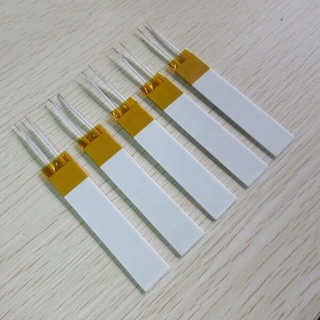
Two types of Alumina ceramic heaters are available at SINOMAS based on different manufacturing technologies. Both are built on high-purity Al₂O₃ ceramic. The difference is in how the heating circuit is integrated — surface-printed or fully embedded. Each approach has a distinct performance profile suited to different OEM design requirements.
Thick Film Heater on Alumina Substrate#
A resistive circuit is screen-printed onto a pre-fired alumina substrate and protected by a glass overglaze layer. The result is an extremely flat, high-watt-density heater that can be customized to any planar geometry.
Key advantages#
Ultra-fast thermal response. High watt density and low thermal mass enables ramp rates up to 150 °C/s, making thick film heaters on Alumina substrate the preferred choice wherever instant heat-up is critical.
Precision watt distribution. The resistor pattern is individually optimized per heating zone rather than uniform across the surface. More heat where needed, less where it is not — without additional components.
Environment friendly. Low thermal mass and minimal residual heat after power-off. Fully RoHS compliant, free of toxic substances and heavy metal ions.
Wide voltage range. From 5V DC (battery-powered applications) up to 480V AC, with three-phase configurations available on request.
Typical applications#
Medical devices · Analytical instruments · 3D printer heated beds · Packaging and sealing machinery · Semiconductor process heating · Inline fluid and gas heating
Co-fired Metal Ceramic Heater (MCH)#
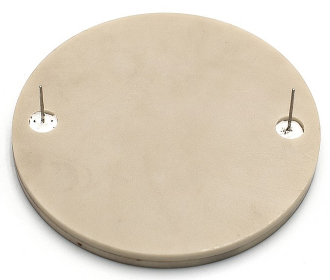
Tungsten paste is printed onto alumina green tape, laminated, and co-sintered at approximately 1600 °C in a reducing atmosphere. The heating element is fully encapsulated inside the ceramic body — no surface exposure, no oxidation risk, significantly higher dielectric strength.

Key advantages#
Fully embedded heating circuit. The tungsten resistor is sealed inside the ceramic body after co-sintering. No surface exposure means no oxidation, no delamination risk, and no contamination of the heated media (fluid or gas) in contact with the heater surface.
Superior dielectric strength. Withstands 4500VAC for a minute in standard testing. The ceramic body itself is the insulator — not a glass overcoat — making MCH the preferred choice for medical equipment, high-voltage OEM assemblies, and applications with strict leakage current requirements.
Rod, tube, needle, and cartridge form factors. MCH can be produced as cylindrical rods from 2 mm diameter, hollow tubes, ultra-thin needles for insertion heating, and press-fit cartridges — geometries that are not achievable with flat-substrate thick film technology.
Excellent thermal cycle durability. The monolithic structure has demonstrated excellent durability in repeated thermal cycling tests, with performance depending on operating conditions and test methods.
RoHS and REACH compliant. Tungsten is the resistive conductor — no lead, cadmium, mercury, or hexavalent chromium. Fully compliant with EU environmental directives.
Typical applications#
- Coffee machines
- 3D printer hot ends
- Dental equipment
- Soldering tools
- Medical probes
- Gas sensor heating (oxygen sensors, NOx sensors, exhaust gas analyzers)
Performance Comparison#
| Parameter | Ceramic Thick film | MCH |
|---|---|---|
| Max operating temperature | 500 °C | 800 °C (limited by lead wire) |
| Peak watt density | up to 50 W/cm² (immersion) | 80–100 W/cm³ |
| Thermal response | up to 150 °C/s | < 30 s to operating temp. |
| Dielectric withstand | 1500 V AC, 1 min | 4500 V AC, 1 min |
| Max voltage | 480 V AC/DC, 3-phase | Up to 240 V typical |
| Integrated RTD sensor | Yes | Optional (design dependent) |
| Form factors | Flat, ring, tube, custom profile | Rod, tube, needle, cartridge |
| Circuit protection | Glass dielectric overcoat | Fully embedded in ceramic |
| Thermal cycle durability | Good | Excellent (monolithic) |
| RoHS / REACH | Yes | Yes — lead-free tungsten |
Neither technology is universally superior. The right choice depends on geometry, voltage, watt density, and integration requirements.
Which Technology Fits Your Design?#
Choose thick film when:#
- Your assembly requires a flat or custom-profile substrate
- You need integrated on-board temperature sensing
- Operating voltage exceeds 220 V, or three-phase supply is required
- Maximum watt density is the primary design constraint
- Fastest possible thermal response is critical (inline fluid heating, on-demand heating)
Choose MCH when:#
- Your assembly requires a cylindrical form factor — rod, tube, needle, or cartridge
- Dielectric strength and leakage current isolation are critical (medical, high-voltage OEM)
- The heater will undergo aggressive thermal cycling
- Compact diameter integration is required (from 2 mm rod)
- Chemical resistance and electrical insulation are important.
Request a Quote#
Both technologies are available for custom OEM orders. Provide your application requirements — operating temperature, voltage, dimensions, watt density, form factor, and target quantity — and we will recommend the most suitable heater technology and design.
Request a Custom Quote